Truth, Saga
& Legend
What’s documented, what’s tradition, what’s storyteller’s flourish.
An annotated history of Cleopatra.
The premise
Cleopatra sits at the most contested historiographic fault line in the ancient record. The Roman tradition that gives us most of what people 'know' about her was built by the regime that killed her. The Egyptian record — coins, temple reliefs, bilingual decrees, the Memphite priestly archive — preserves a different woman. This page tells you which parts you should take to heart, which parts you should hold loosely, and which parts are pure Roman propaganda hardened into pop-culture by Shakespeare and Hollywood.
The single richest narrative source is Plutarch's Life of Antony (c. 110 AD), written roughly 140 years post mortem in Greek, working from older sources (some now lost — Plutarch names Cleopatra's physician Olympus as a source for the death scene). Plutarch is detailed, dramatic, and Roman-framed in the specific way Greek imperial historians always are: respectful of his subject, sceptical of the propaganda, but writing inside the worldview the regime created.
Cassius Dio's Roman History (c. 225 AD) covers the same arc with full access to Augustan-era state records, and is more openly hostile. Suetonius, Vergil's Aeneid Book VIII, and Horace's Odes 1.37 are the Augustan-period literary apparatus that hardened the seductress-myth into civic literature within a generation of her death.
The Egyptian record is older, simpler, and harder. Her coins struck at Alexandria and the Roman East mints show her in pharaonic regalia with a hard, hawkish profile. Her temple relief at Dendera survives in situ — she stands in Hathor-Isis regalia with Caesarion as Horus, performing rites her predecessors had only watched. Her bilingual decrees grant her the title Thea Neotera, 'the Younger Goddess.' The Donations of Alexandria ceremony in 34 BC is attested by three independent hostile Roman sources, which means even the propaganda tradition cannot deny it happened.
Verdicts below: Documented · From the sources · Legend & flourish.
Documented
What multiple independent sources agree on.Cleopatra was the last pharaoh of an independent Egypt.
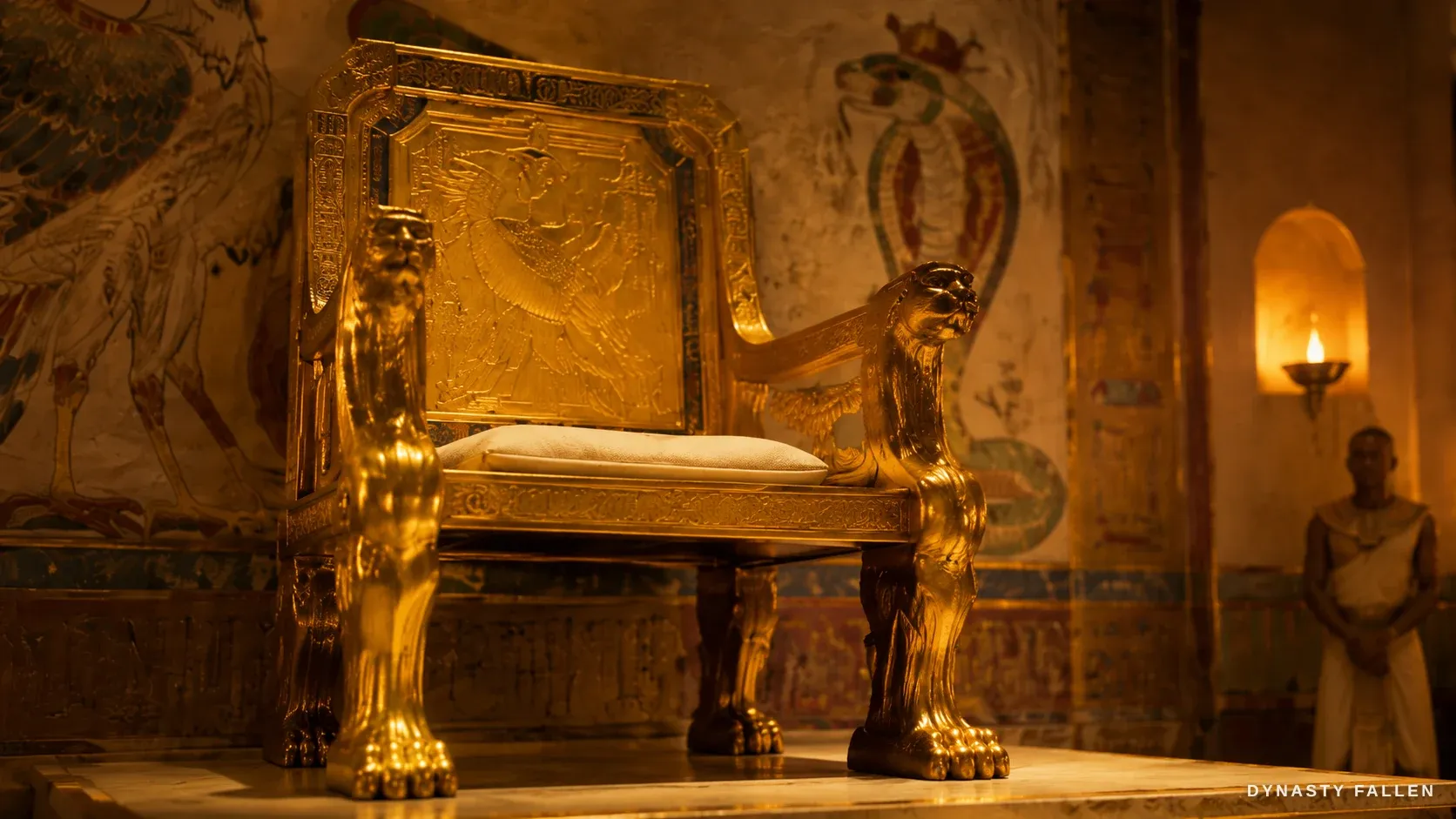
Cleopatra co-ruled with her son Caesarion (Ptolemy XV) until her death on 12 August 30 BC. Caesarion, age seventeen, was lured back from his attempted flight south on Octavian’s promise of safe passage and was killed within weeks — reportedly on the advice of the philosopher Areius Didymus, who told Octavian “it is not good to have too many Caesars.” Egypt was formally annexed as a Roman province on 31 August 30 BC. The Ptolemaic dynasty — founded by Alexander’s general Ptolemy I in 305 BC — ended with her, and so did the line of pharaohs that stretched back three thousand years to the First Dynasty unification of Upper and Lower Egypt.
Cleopatra was the first Ptolemy in three centuries to learn the Egyptian language.
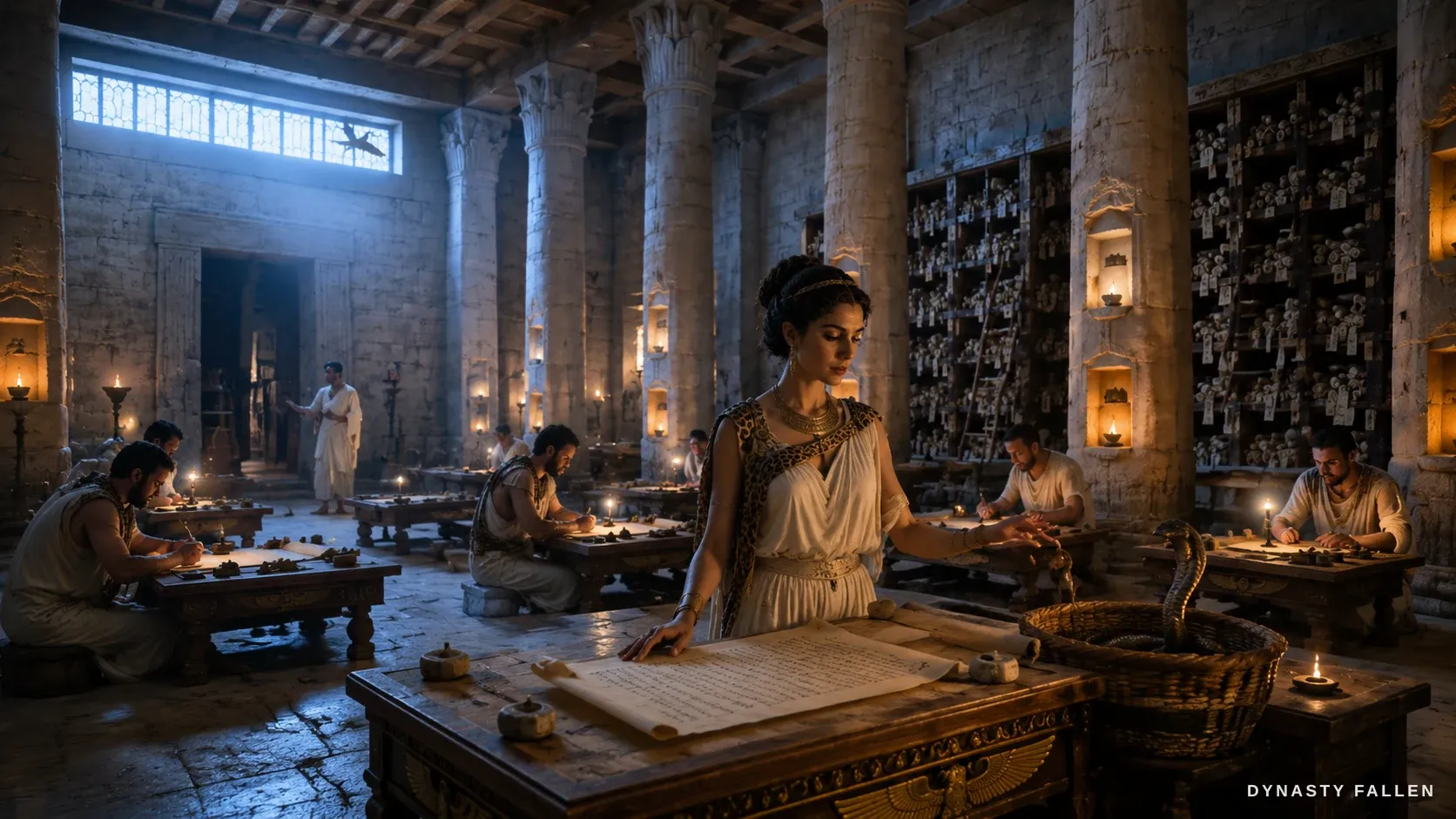
The Ptolemaic dynasty had ruled Egypt in Greek for more than two and a half centuries without learning the language of the country — the kings spoke Greek, the administration ran in Greek, and the Egyptian-language priesthood was managed through translators. Plutarch (Life of Antony 27) singles Cleopatra out as the first of her line to bother: she spoke Egyptian, he says, along with eight or nine other tongues, and her voice was “an instrument of many strings, which she could turn to any language she pleased.” The surviving bilingual decrees of her reign confirm she had Egyptian-language administrative competence; the Memphite priestly decree at her coronation names her by the full Egyptian pharaonic titulary in a register that earlier Ptolemies had not received. The historical claim has to be carefully phrased — she was the first to speak it at her own coronation, not necessarily the first Ptolemy ever to know any Egyptian — but the structural shift was real, and it changed her relationship to the priestly class on whom her legitimacy depended.
Cleopatra performed Isis-incarnation as state religion — not as metaphor.
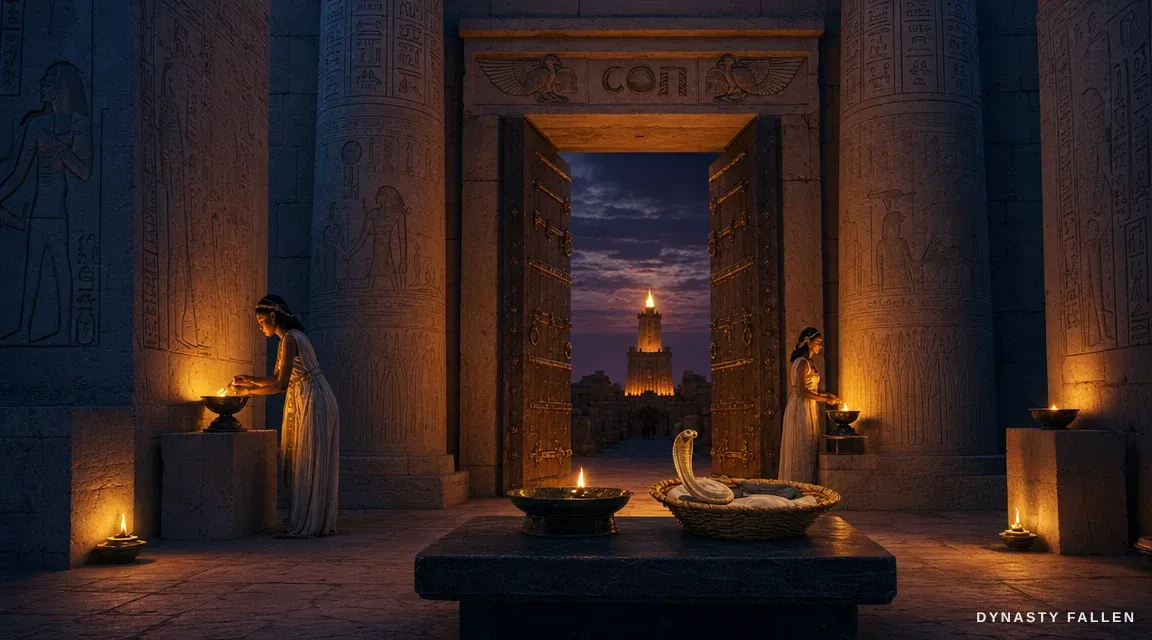
This is the album’s load-bearing claim, and it is among the best-documented facts of her reign. Five lines of evidence converge on the same conclusion: (a) Cleopatra granted herself the title Thea Neotera — “the Younger Goddess” — in her own bilingual decrees, and her administration carried it. (b) The Dendera temple relief, paid for by her treasury during her co-regency with Caesarion, shows her in full Hathor-Isis regalia performing temple rites alongside her son as Horus. The relief survives in situ. (c) Her coinage in Egypt and the Roman East depicts her in pharaonic regalia — the Uraeus, the wesekh collar, the diadem — not in the Hellenistic-Greek queen-iconography her predecessors had used. (d) Multiple papyri from her reign record priestly decrees granting her divine honours in Egyptian temples. (e) Her ceremonial appearances at state festivals dressed and acting as Isis are attested in Plutarch (Life of Antony 54) and in independent Greek-language sources.
This was not a poetic flourish. Earlier Ptolemaic queens had played priestess roles in Isis festivals — Arsinoe II had been deified after death and syncretised with Aphrodite and Isis a century earlier — but Cleopatra took the existing royal-priestess role and pushed it to its theological maximum. She did not merely serve the goddess. She claimed to be her. The Egyptian populace appears to have taken the claim literally; the Roman tradition could not absorb it and translated it into the seductress-myth instead.
At the Donations of Alexandria in 34 BC, Cleopatra distributed Roman-conquered territories to her divine children.
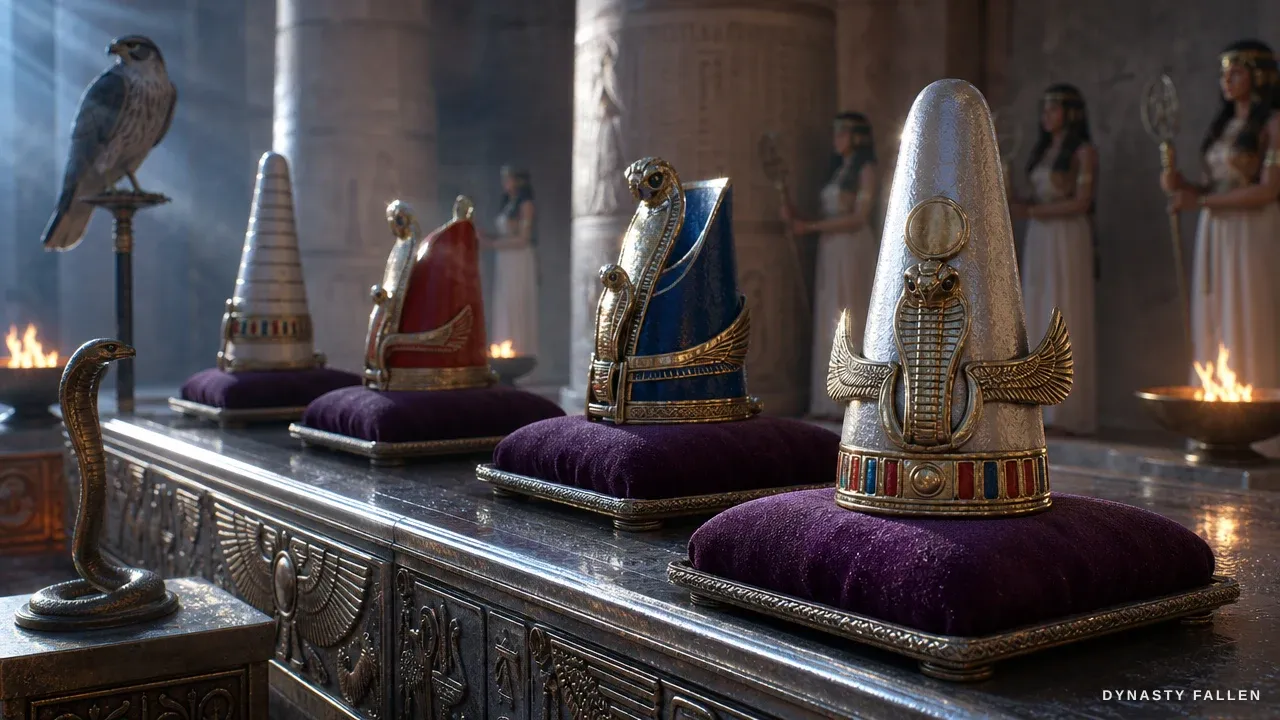
The Donations ceremony is among the best-attested events of Cleopatra’s reign, precisely because the Roman propaganda war needed it to have happened. Octavian used the ceremony as the central charge against Antony in the run-up to Actium; the Senate’s formal declaration of war in 32 BC named it explicitly. Three independent hostile Roman sources describe it: Plutarch (Antony 54), Cassius Dio (Roman History 49.41), and indirectly Suetonius (Augustus 17). When the propaganda tradition itself confirms an event, the event is bedrock.
In the Gymnasium of Alexandria, Cleopatra sat enthroned as Isis on a silver dais. Caesarion was proclaimed King of Kings and confirmed as the legitimate son of Julius Caesar — a direct strike at Octavian’s claim to be Caesar’s heir. Alexander Helios (age six) was given Armenia, Media, and Parthia — the last two not actually Roman possessions, a forward territorial claim. Cleopatra Selene II (his twin) was given Cyrenaica and Libya. Ptolemy Philadelphus (age two) was given Syria and Cilicia. Antony presided as Osiris-Dionysus. Cleopatra herself was styled Queen of Kings. (Dio’s territorial assignments differ slightly from Plutarch’s; both agree on the central architecture.)
This was the single most explicit act of divine self-claim by a late-antique monarch, and it was the moment the Roman political class concluded that Cleopatra had to be destroyed. The album treats it as the second-act peak.
Cleopatra bore Julius Caesar a son — Caesarion, Ptolemy XV.
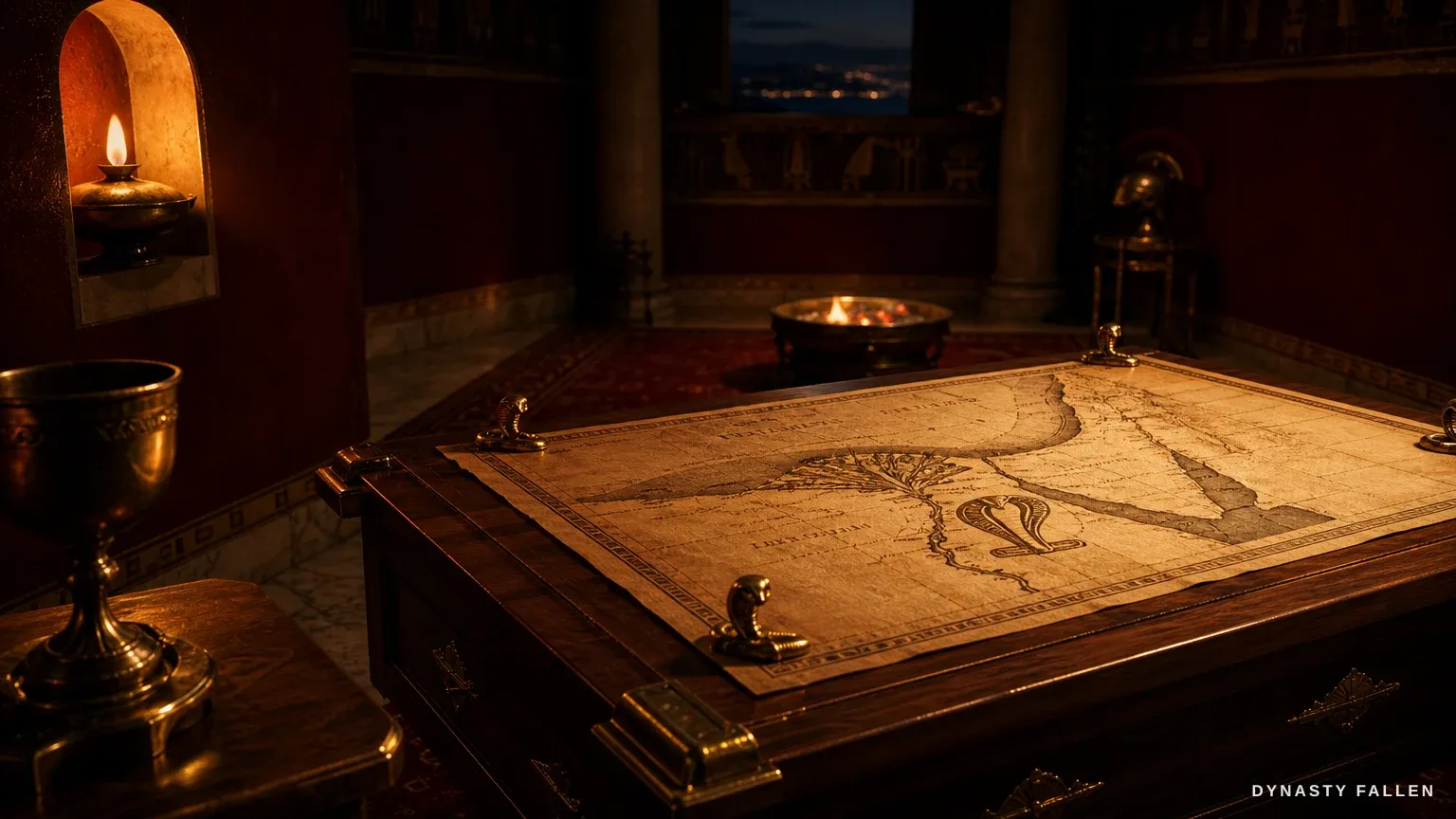
Cleopatra named the boy Ptolemy Caesar (Ptolemy XV); Caesarion — “little Caesar” — was the popular Alexandrian name. He was born in 47 BC, shortly after Caesar’s restoration of Cleopatra’s throne. The paternity was politically explosive: if Caesarion was Caesar’s biological son, he was a more direct heir than Octavian (Caesar’s adopted grand-nephew), and Octavian’s claim to be Caesar’s legitimate successor was structurally weaker. Antony confirmed the paternity at the Donations of Alexandria in 34 BC, explicitly proclaiming Caesarion as Caesar’s son — which is why Octavian then disputed it through the propaganda apparatus. Suetonius records that some of Caesar’s friends denied the paternity, but the timeline (Cleopatra was in Caesar’s household when the boy was conceived) and Caesar’s own behaviour (he did not deny paternity in his lifetime, accepted the boy as his, and Cleopatra and Caesarion lived in his Roman villa on the Janiculum) point the other way.
Modern historians (Schiff, Roller, Tyldesley) generally accept the paternity. Caesarion was murdered on Octavian’s order within weeks of his mother’s death.
Octavian's triumph in 29 BC had to parade a wax effigy of Cleopatra — because the real one was unavailable.
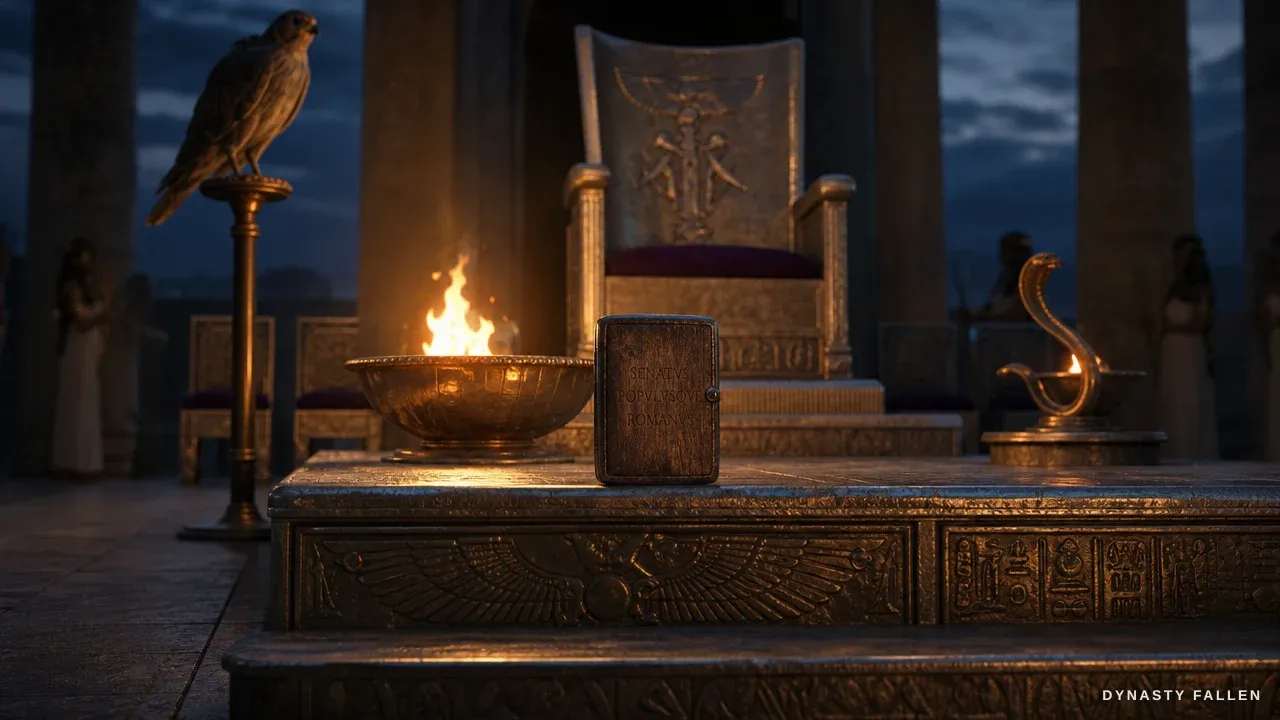
The Roman triumph was state theatre. A defeated foreign monarch walked in chains behind the triumphator’s chariot, was shown to the crowd, and was often killed at the foot of the Capitol at the climax. Octavian’s Egyptian triumph in August 29 BC needed Cleopatra in that role — the queen whose defeat had ended the civil wars and made Octavian master of Rome.
Cleopatra denied him the parade. Her chosen death in the mausoleum on 12 August 30 BC meant the triumph had to substitute a wax effigy — the queen in painted likeness, with an asp shown biting her arm or breast. Multiple Roman sources confirm the effigy: Plutarch records it, Dio describes it, and Propertius’s elegy 3.11 alludes to it within four years of the triumph itself. The effigy was a public admission of what Cleopatra had taken from Octavian: not just the strategic victory, but the propaganda climax that the strategic victory was meant to enable.
The album closes Track 10 on this beat. Before the Roman triumph, before the wax effigy, before the parade — there was the cobra, and the cobra knew her name.
Caesarion was killed on Octavian's order in 30 BC, age seventeen.
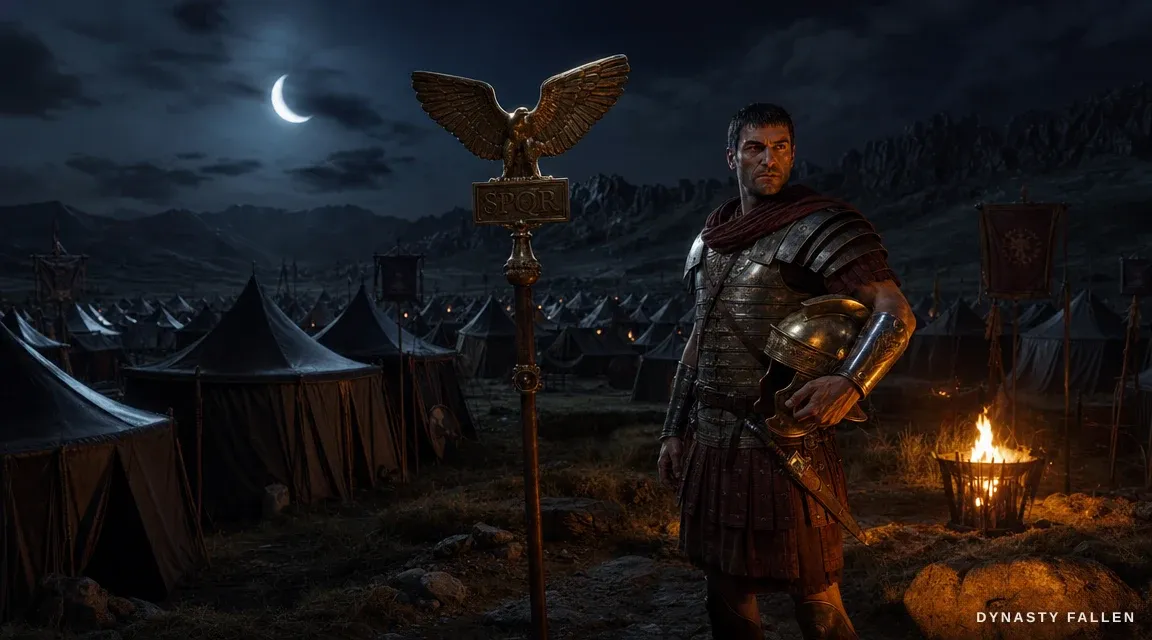
Cleopatra sent Caesarion south toward Berenice with his tutor Rhodon, intending to put him on a ship for India and out of Octavian’s reach. Rhodon, on Octavian’s promise of safe conduct, persuaded the boy to return north. He was killed shortly after his mother’s death, age seventeen. Plutarch records that Octavian deliberated and was advised by the philosopher Areius Didymus with a play on Homer: οὐκ ἀγαθὸν πολυκαισαρίη — “it is not good to have too many Caesars.” The phrasing is Plutarch’s polish; the decision is Octavian’s.
The killing closed the Ptolemaic line. It also closed the most dangerous political loose end Octavian faced: Caesarion was simultaneously Cleopatra’s legitimate son, Antony’s publicly-confirmed dynastic heir at the Donations of Alexandria, and — if his paternity was real — Julius Caesar’s only biological son. Three threats in one body. Octavian solved all three with the same order.
Cleopatra Selene II survived — and became Queen of Mauretania.
Of Cleopatra’s four children, only Cleopatra Selene II — the daughter born to Antony in 40 BC — had a fully-documented life after 30 BC. After her mother’s death she was taken to Rome at age ten and raised in Octavia’s household alongside Antony’s Roman children. Around 25 BC, when she was about fifteen, Octavian (now Augustus) married her to Juba II, a Roman-educated North African prince whom Augustus had installed as client king of Mauretania.
Selene ruled at Caesarea (modern Cherchell, Algeria) as queen consort. Her coinage survives. It is the most evocative survival of her mother’s legacy: Selene’s coins carry Isis iconography — the sistrum, the crocodile, the headdress — in a region that had no native Isis cult. She was performing her mother’s religion deliberately, in the Roman client kingdom Augustus had given her. She bore Juba a son, Ptolemy of Mauretania, and probably a daughter. She died around 5 BC. Her son ruled Mauretania until the emperor Caligula had him executed in 40 AD, ending the Ptolemaic line at last.
The album does not give Selene a track. The claim is here so the page closes on the fact that the goddess-frame did not die at the mausoleum — it travelled west, in Selene’s coinage, for one more generation.
The two boys crowned at the Donations — Alexander Helios and Ptolemy Philadelphus — vanish from the record after Octavian's triumph.

The Donations of Alexandria was, before it was anything else, a coronation of children. Alexander Helios — Cleopatra’s son by Antony, born 40 BC, twin of Cleopatra Selene — was led out at age six in full Median dress, the tiara and upright kitaris of a Parthian king, and proclaimed King of Kings over Armenia, Media, and Parthia. To seal the eastern claim he was betrothed to Iotapa, the small daughter of the king of Media Atropatene, who was brought to Alexandria to be raised as his bride. His younger brother Ptolemy Philadelphus, born 36 BC, was carried out at age two in Macedonian royal dress — the kausia, the chlamys, the boots — and given Syria and Cilicia. The costumes were the argument: a Ptolemaic son for the Greek west, a Ptolemaic son for the Persian east, the whole inheritance of Alexander parcelled out under Cleopatra’s children. This is what the Roman sources could not forgive, and why the ceremony is so well attested (Plutarch, Antony 54; Dio 49.40–41).
After Actium and the deaths of their parents, the documented thread continues a little further. The three surviving children — the two boys and their sister Selene — were taken to Rome and walked in Octavian’s triumph of 29 BC, behind the gold effigy of their mother with the asp at her arm (Dio 51.21). Octavian then handed them to his sister Octavia, Antony’s discarded Roman wife, who raised them in her own household alongside Antony’s Roman children — an act of calculated mercy and an equally calculated erasure.
And there the record simply stops. Selene’s life is documented onward to her marriage and her Mauretanian coinage; her two brothers are never mentioned again. Dio’s one ambiguous line — that Octavian “gave Alexander and Ptolemy to Juba and Cleopatra” — is sometimes read to mean the boys travelled west with their sister, but no source records them arriving, marrying, ruling, or dying. The silence is itself a kind of evidence: a surviving son of Antony and Cleopatra would have been a political fact someone wrote down. The likeliest reading is that both boys died young, of illness, in Octavia’s house in Rome, within a few years of the triumph. The kingdoms handed to them on the silver dais in 34 BC outlived the children by not even a decade.
From the sources
Mostly Historia Augusta. Plausible, vivid, but unverified by independent sources.She spoke nine languages.
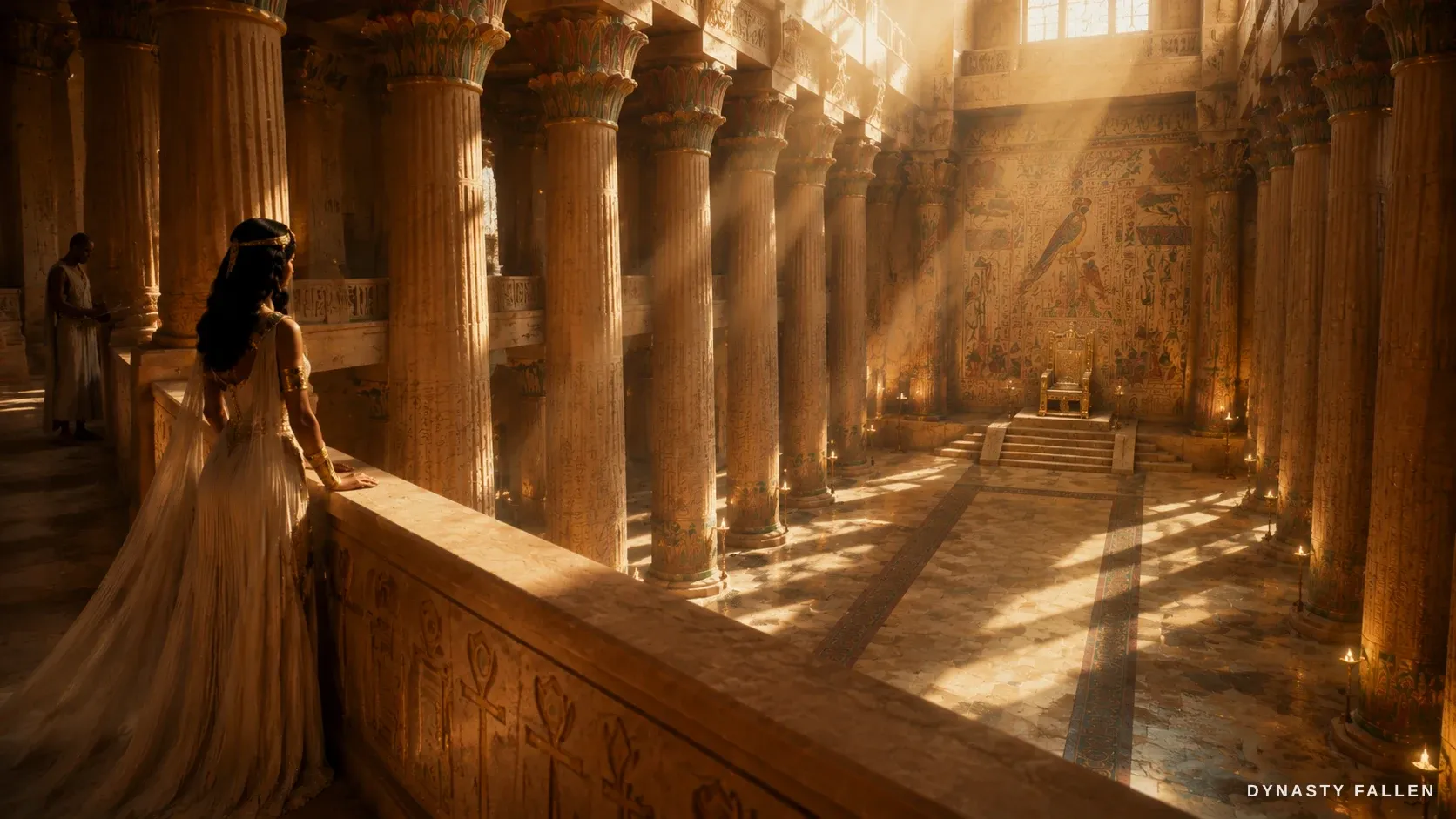
The full list comes from Plutarch alone (Life of Antony 27): Egyptian, Ethiopian, the language of the “Troglodytes” (probably a Red Sea tribe), Hebrew, Arabic, Syriac (Aramaic), Median, Parthian, and “many others.” Plus Greek and Latin she would have had as a Ptolemaic-educated queen, giving the famous nine-or-more figure. Plutarch says her tongue was “an instrument of many strings, which she could turn to any language she pleased.”
It is plausible. A serious Ptolemaic education would have produced Greek and Latin, and a queen of her diplomatic ambitions would have had pragmatic working knowledge of the languages of her eastern counterparts — Hebrew and Aramaic for Judaea, Arabic for the Nabataean trade routes, Median and Parthian for the Persian east. The Egyptian was the documented break with her dynasty (see first Ptolemy to speak Egyptian). The full nine is unverifiable in any independent source.
The album takes the nine-languages claim as part of Cleopatra’s intellectual-challenge register without pretending it is fully attested. If you want the cautious version, she certainly spoke at least four (Greek, Latin, Egyptian, Aramaic). If you want Plutarch’s queen, she spoke them all.
The barge at Tarsus — golden, purple sails, silver oars, Cleopatra costumed as Aphrodite.
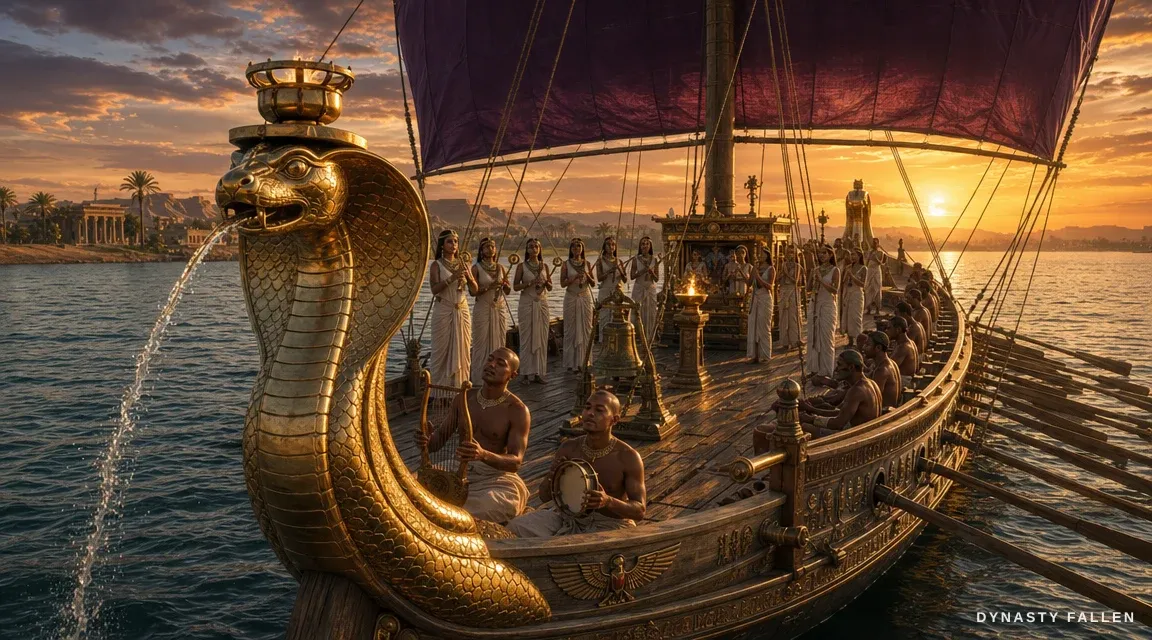
Plutarch’s description of Cleopatra’s arrival on the river Cydnus to meet Antony at Tarsus in 41 BC is one of the most quoted passages in ancient literature: the gilded stern, the purple sails, the silver oars keeping time to flutes and pipes, the queen costumed as Aphrodite reclining beneath a canopy of cloth-of-gold, attended by boys dressed as Cupids and slave-girls as sea-nymphs. Shakespeare’s “the barge she sat in, like a burnished throne, burned on the water” is direct verse paraphrase. The image is iconic precisely because Plutarch wrote it well.
What is documented: the meeting itself (Cydnus, 41 BC, Cleopatra summoned by Antony to answer accusations of having aided Cassius against the Caesarian party at Philippi), Cleopatra’s arrival in elaborate style, and the political outcome (Antony followed her back to Alexandria for the winter and the relationship began). What is Plutarch’s set-piece: the specific staging — the precise costuming, the specific number of attendants, the chorography. Plutarch is writing 140 years after the event from older sources, with literary intention.
What is documented in the Egyptian record: the Aphrodite-Isis syncretism that the staging draws on was Cleopatra’s actual self-presentation. Isis had been syncretised with Aphrodite across the Hellenistic Mediterranean for two centuries by then; Cleopatra’s coinage in the Roman East includes Aphrodite-Isis iconography. So the costume was not Plutarch’s literary invention — it was the religious frame Cleopatra had been performing for a decade. Plutarch’s flourish is the specific staging. The frame is hers.
The album commits to the barge as the album-plan’s Track 05 set-piece — with the syncretism named explicitly rather than left as Plutarch’s flourish.
She died by the bite of an asp at her breast — the cobra of Lower Egypt returning to the goddess.
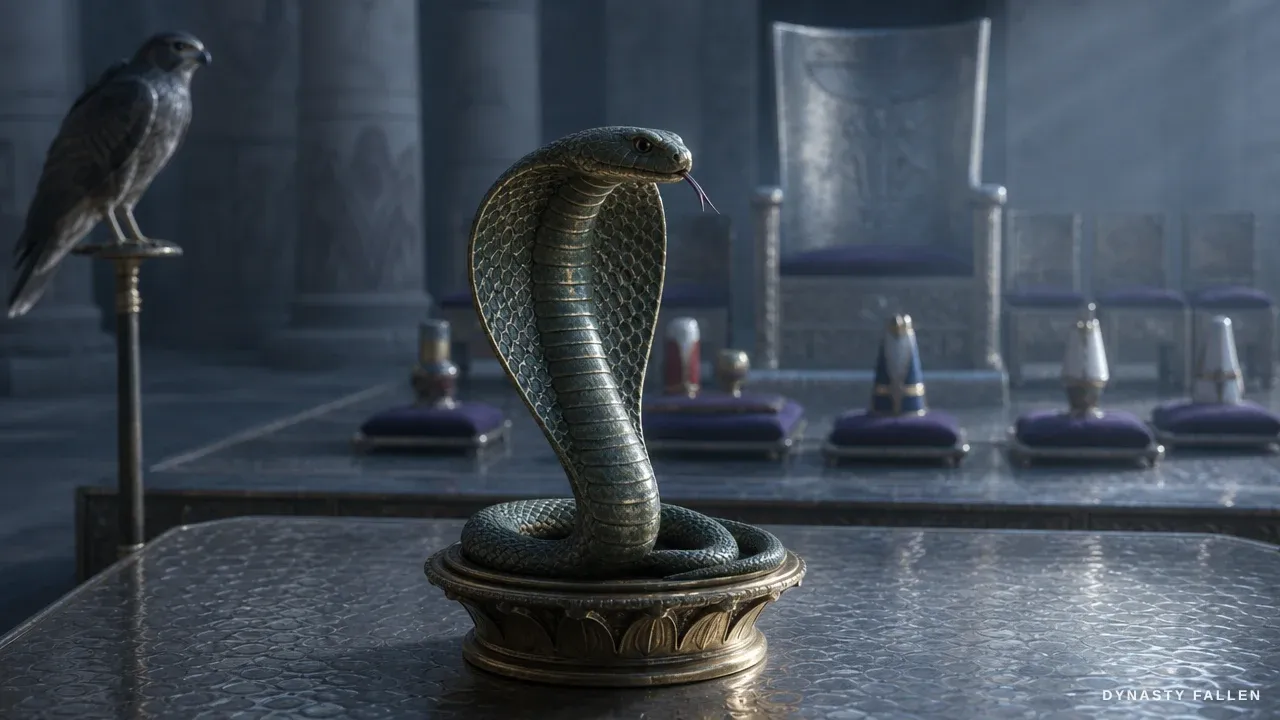
The death is documented in outline. Cleopatra died in her mausoleum at Alexandria on 12 August 30 BC, age thirty-nine, with at least two of her handmaidens (Iras and Charmion). Plutarch and Dio agree on the outline. They disagree on the specifics, and Plutarch himself records uncertainty about the exact mechanism — he lists alternative theories (a poisoned hairpin, a self-administered poison kept in a hollow comb) and concludes “what really took place no one knows.”
What is documented as the official version: an asp brought into the mausoleum in a basket of figs and applied to her breast (or her arm, depending on the source). The decisive corroborating evidence is that Octavian’s triumph in Rome in 29 BC paraded a wax effigy of Cleopatra with an asp shown biting her, which means the asp narrative was the official Roman version within eighteen months of her death — regardless of whether it was the actual mechanism.
What modern toxicology questions: a single cobra bite kills slowly and messily over hours, not the clean and rapid death described. Three women dying within an hour from snake-venom is implausible. The most likely actual mechanism was a poison — hemlock or aconite — chosen for clean rapidity. The cobra was the symbol she wanted to leave behind, not necessarily the instrument.
What the Egyptian frame contributes: the cobra-Wadjet reading. Wadjet was the cobra-goddess of Lower Egypt, the Uraeus on every pharaoh’s brow, the protector of the infant Horus — and by syncretism the serpent of Isis. The album reads Cleopatra’s chosen death-symbol as a deliberate Wadjet identification, completing two decades of Isis-performance with the cobra of her own state religion. This is modern scholarly synthesis (Ashton, Witt, Tyldesley), supported by the timing and the iconography but not directly stated in any ancient source.
The album commits to the asp/Wadjet reading. The page is honest that the actual mechanism may have been hemlock.
Charmion's last words: *'Exceedingly well done, and fitting of so many kings.'*
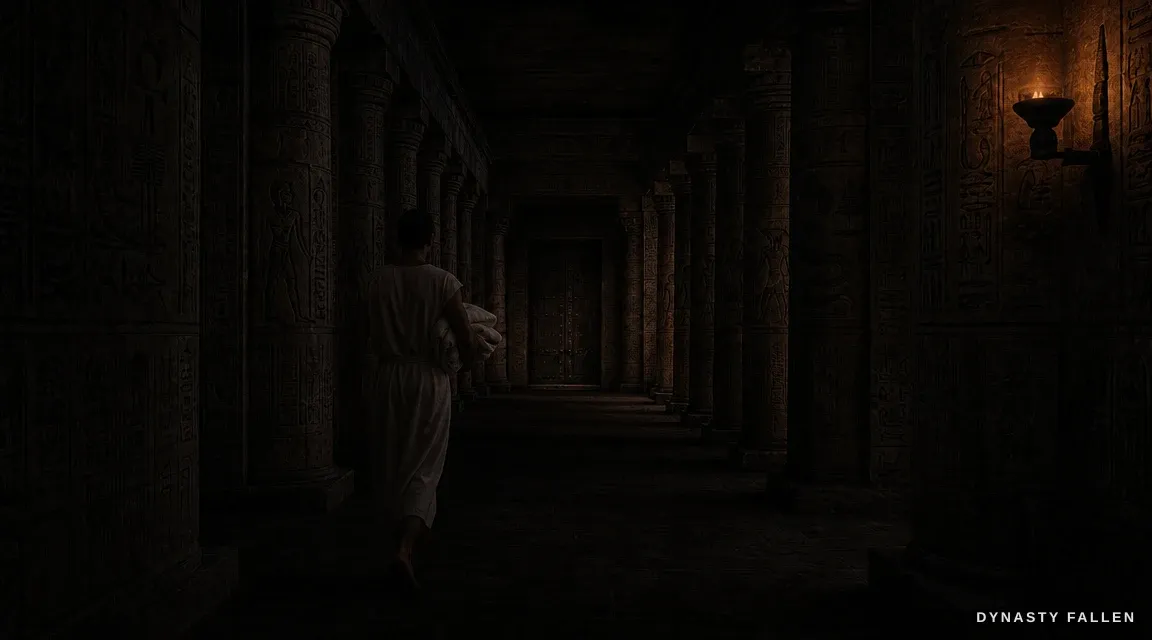
Plutarch closes his Life of Antony on the exchange. A Roman soldier breaks into the mausoleum and finds Iras dead on the floor and Charmion swaying, adjusting the diadem on the dead queen’s head. The soldier asks angrily, “Is this well done, Charmion?” — meaning, was this an honourable thing to do? And Charmion answers, in the Greek: καλά, καὶ πρεπόντως τοσούτων βασιλέων ἀπογόνῃ — “Extremely well, and as befits the descendant of so many kings.” Then she falls.
Plutarch is the sole source. The exchange has the polish of careful literary reconstruction — the parallel structure, the καλά answer to the soldier’s καλῶς, the rhetorical compression. It is the kind of exchange that gets reconstructed in literature from a known outcome and a remembered shape. Whether Charmion said those exact words is unverifiable. That she was alive when the Romans broke in, that she was attending the queen’s body, and that she died very shortly after — those are documented.
The album uses the line as Track 10’s closing, given verbatim in the older translation form. The historical claim it carries is the larger one: Cleopatra’s handmaidens chose to die with her, in the Egyptian manner, attending their queen into the afterlife.
Legend & flourish
Where the source becomes legend.She was smuggled into Julius Caesar's chambers rolled in a carpet.
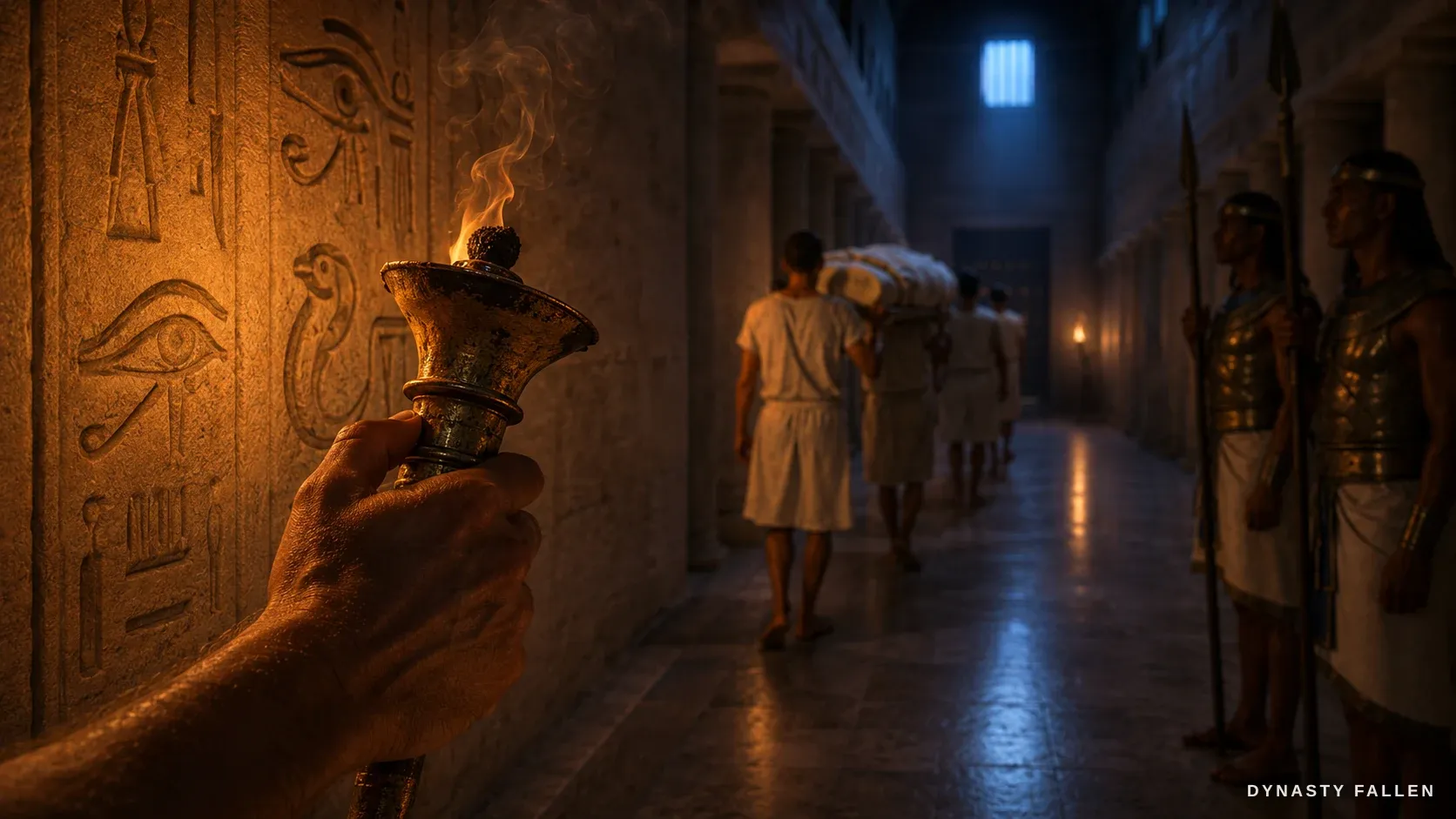
This is the most famous Cleopatra image in popular memory and it is partly wrong. The carpet is a twentieth-century Hollywood embellishment. Plutarch (Life of Caesar 49) records that Cleopatra was smuggled past her brother-husband Ptolemy XIII’s guards into Caesar’s chambers in the royal palace — but the word he uses is strōmatodesmos (στρωματόδεσμος), which means a bedding-sack: a long bag of cloth used to bind up linen for transport. The carpet appears nowhere in the ancient sources. It is the visual invention of Cecil B. DeMille’s 1934 Cleopatra film and Joseph Mankiewicz’s 1963 Elizabeth Taylor Cleopatra — Hollywood substituting the more visually striking carpet for the more accurate but less photogenic linen sack.
What is documented is the smuggling itself and its political logic. Cleopatra had been deposed by her brother and was outside Alexandria with a mercenary army; she could not enter the city overland without being killed by Ptolemy’s faction. Caesar had arrived in Alexandria in October 48 BC and taken up residence in the royal palace, formally neutral but with the power to restore her. The smuggling was a calculated diplomatic act: she needed face-to-face access to Caesar before her brother’s people could prevent it, and the linen-sack was the means.
The album’s Track 03 (The Linen and the Reborn) takes the smuggling and reframes it — not as seduction, not as adventure-romance, but as Isis going underground to be reborn into the light of Caesar’s chamber.
Cleopatra was a great beauty.
Plutarch — the writer who did the most to make Cleopatra a literary figure — says explicitly in Life of Antony 27 that her beauty “was not in itself altogether incomparable, nor such as to strike those who saw her.” Her power, he says, was her charm, her voice, her wit, her presence. She held conversation, she switched languages mid-sentence, she had the political intelligence of a much older queen at twenty. None of that is beauty in the Hellenistic-portraiture sense.
Her own coinage confirms it. The Cleopatra coin corpus — struck at her own Alexandria mint and at the Roman East mints during her reign — shows a strong-jawed, sharp-nosed, hawkish profile. Hooked nose, prominent chin, set mouth. She is recognisably a woman, recognisably a queen, recognisably not the Hellenistic-beauty ideal. The portraits are her authorised public image; she had editorial control of her own coinage, and she chose to be portrayed this way. If she had wanted to look like Aphrodite, she could have. She wanted to look like a pharaoh.
The great-beauty trope was hardened by Propertius and the Augustan poets writing after her death, then locked in by Shakespeare’s “age cannot wither her, nor custom stale,” and then turned into cinema by Theda Bara (1917), Claudette Colbert (1934), and Elizabeth Taylor (1963). It is one of the most successful pop-cultural inventions in history. The album rejects it.
She seduced both Caesar and Antony — the foreign temptress who corrupted two Romans.
The seduction-of-two-Romans frame is the foundational charge of the Roman tradition, and it was constructed deliberately. Propertius’s elegy 3.11 calls her regina meretrix — “whore queen.” Horace’s Odes 1.37 celebrates her death as Rome’s deliverance from a fatale monstrum. Vergil paints Actium as Roman gods defeating Egyptian ones. The frame was built by Augustan-era poets working at the court of the man who had killed her, and it was built precisely because the political alternative was unbearable: that Caesar and Antony — two of Rome’s greatest commanders — had made informed strategic choices to ally with an Eastern queen who was their political equal.
The Egyptian record reads both relationships as statecraft. Caesar’s protection in 48–47 BC restored Cleopatra’s throne after a civil war her brother had been winning — she needed Roman military weight; he needed Egyptian grain, gold, and a stabilised Eastern frontier. Antony’s Egyptian-style marriage (never formalised under Roman law) consolidated the Eastern Mediterranean under a coherent Roman-Egyptian command structure — she needed his legions; he needed her fleet, her wealth, and her religious legitimacy in the East. Both relationships produced children whom Cleopatra incorporated into Egyptian state religion: Caesarion as Horus at the Donations, the twins and Philadelphus as junior deities receiving territorial assignments. These are the moves of a sovereign making dynastic alliances. They are not the moves of a courtesan.
The album rejects the seduction frame in Track 03’s bridge: I did not seduce Caesar — I delivered a kingdom to the room. The historical Cleopatra was bargaining from a position of structural weakness (Egypt was a Roman client state by the time she inherited it), but she was bargaining as a head of state, and both Romans appear to have understood that.
A note on stance
Why the album holds the position it does
The album takes the Egyptian side on the explicit grounds that the Roman record was propaganda by the man who killed her. The Roman sources are used for the documented external events — the battles, the meetings, the deaths, the dates — those things Plutarch and Dio cannot easily have invented. The Roman sources are not used as the frame for Cleopatra's interior life, her motivations, or her relationship to her own divinity.
If you want the Roman Cleopatra, she was a foreign temptress who corrupted two great Romans and was rightly destroyed by Augustus. If you want the Egyptian Cleopatra, she performed Isis as state religion for two decades, distributed Roman-conquered kingdoms to her divine children, and chose the cobra of Lower Egypt rather than walk in Octavian's parade.
Vol. VII is for the Egyptian queen. This page is so you can hold both at once.
Sources & further reading
What the album draws from, and modern scholarship for digging deeper.Primary sources
- Life of Antony
The principal narrative source. The Tarsus barge, the Donations of Alexandria, Actium, the mausoleum, the asp, and Charmion's last words are all here. Roman-framed but respectful. Plutarch names Cleopatra's physician Olympus as one of his sources for the death scene; Olympus's writings do not survive.
- Life of Caesar
The Caesar period: Cleopatra's smuggling into his chambers in a stromatodesmos ('linen-bundle'), Caesar's restoration of her throne after the Alexandrian War, the early years.
- Roman History, Books 42–51
Roman senator with access to Augustan-era state records. Particularly important for Actium (Book 50) and the death scene (Book 51). More overtly hostile than Plutarch.
- Lives of the Twelve Caesars — Julius, Augustus
Useful for the Caesarion-paternity dispute, Octavian's treatment of Cleopatra's children, and the wax-effigy detail of the 29 BC triumph.
- Aeneid, Book VIII (Shield of Aeneas)
Direct Augustan-era propaganda in epic form: Actium depicted as Roman gods defeating 'monstrous gods of every form, and barking Anubis.' Establishes the cosmological frame Octavian used to justify the war.
- Odes 1.37 (Nunc est bibendum)
The Augustan court poet's ode on Cleopatra's death — celebrating the defeat but grudgingly admiring the manner of her end ('not a humble woman, she chose to die nobly').
- On Isis and Osiris (Moralia 351–384)
The fullest Greek-language synthesis of the Egyptian Osiris myth-cycle. Not directly about Cleopatra but the standard source for the Isis theology she performed.
- Egyptian inscriptional record
The Dendera temple relief shows Cleopatra in Hathor-Isis regalia with Caesarion as Horus, performing temple rites. The Philae and Coptos inscriptions and her bilingual decrees grant her the title Thea Neotera. Documents her self-presentation as Isis-on-earth as state religion.
- Numismatic record
Surviving Cleopatra coinage shows her in pharaonic regalia (the Uraeus, the wesekh collar, the diadem) with a hard, hawkish profile — very far from the Hellenistic-beauty trope. Catalogued in the Roman Provincial Coinage corpus.
Modern scholarship
- Cleopatra: A Life
The most readable modern biography. Reconstructs Cleopatra against the Roman record while giving full weight to the Egyptian evidence. The standard popular work.
- Cleopatra: A Biography
The more scholarly modern biography. Strong on the political and dynastic context. The standard academic reference.
- Cleopatra: Last Queen of Egypt
An Egyptologist's reading — gives full weight to the Egyptian-priestly evidence and the Isis identification. The strongest treatment of the Egyptian-record side of the historiographic split.
- Cleopatra and Egypt
Specialist study of Cleopatra's Egyptian iconography and royal self-presentation. The most thorough treatment of the Isis identification.
- Isis in the Ancient World
The standard study of the Hellenistic-Roman Isis cult — the Greco-Roman syncretism, the temples at Pompeii and Rome and Delos, the priesthood as state office.
- Cleopatra and Rome
Specifically on the Roman reception and the Augustan propaganda war. The companion volume for understanding how the seductress-myth was constructed.
- The Complete Gods and Goddesses of Ancient Egypt
Standard reference for Egyptian iconography including Isis, Wadjet, Hathor, and the crowns.
Read online
- Plutarch, Life of Antony (Perseus Project)
The full English text of Plutarch's Antony, hyperlinked Greek-and-English.
perseus.tufts.edu → - Cassius Dio, Roman History (Perseus Project)
Dio's full Roman History online; Books 42–51 cover the Cleopatra arc.
perseus.tufts.edu → - Rehabilitating Cleopatra
Schiff's essay summarising the scholarly reframing — the case for taking the Egyptian record seriously.
smithsonianmag.com → - Dendera temple relief — Egyptology online
Photographs and documentation of the Dendera temple, including the surviving relief of Cleopatra as Hathor with Caesarion as Horus.
osirisnet.net → - Wikipedia — Cleopatra VII
Useful starting point and hyperlinked entry into the source-critical debate.
en.wikipedia.org →
Citations on individual claims above point to specific chapters and editions. The list here is the broader context — what to read next if you want to follow the queen out of the song and into the historical record.