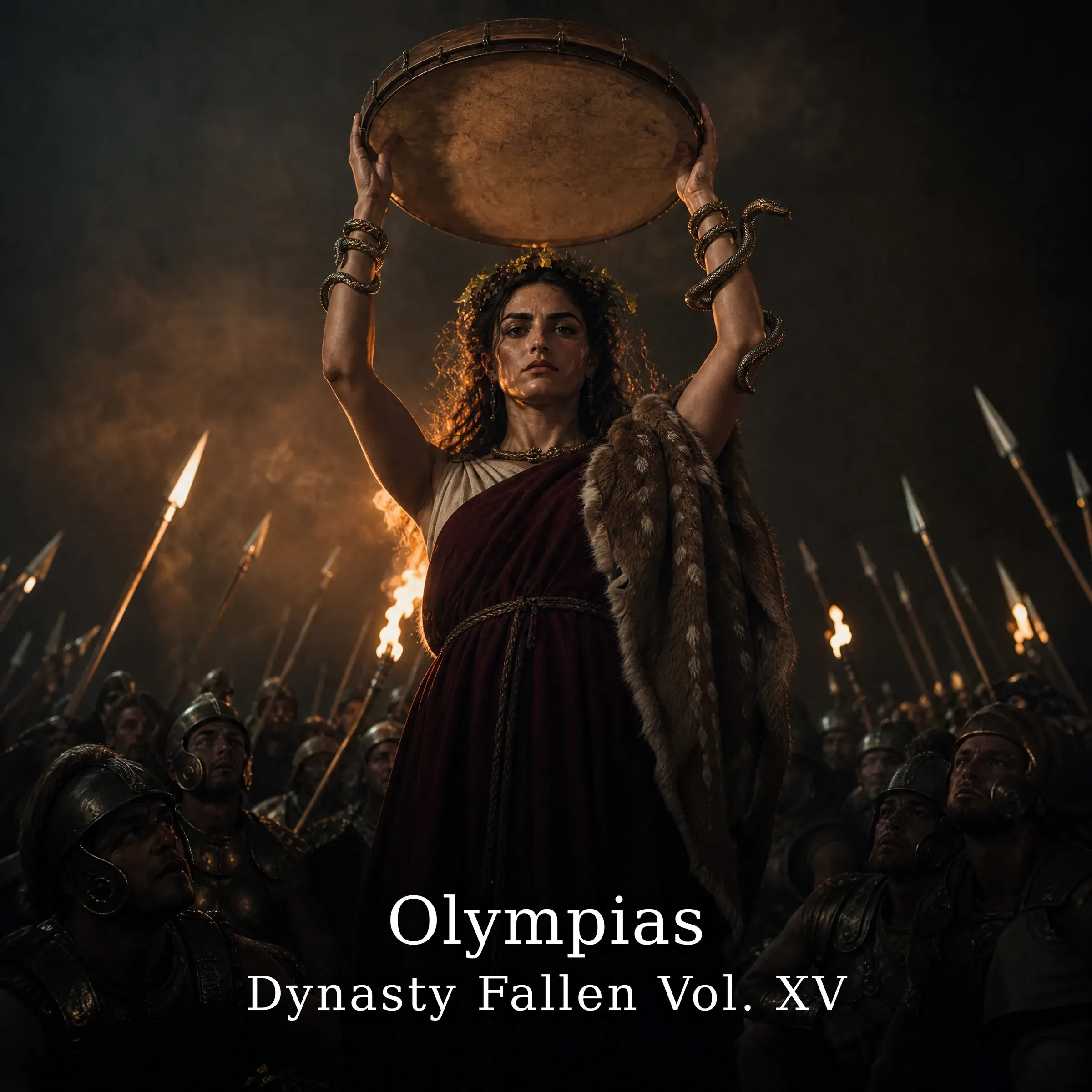
Dynasty Fallen · Vol. XV

Olympias
of Epirus

Mother of Alexander. Bride of the god. The queen they could not strike down.
She never drew a sword — an army knelt to her name, and the men sent to kill her could not lift the blade.

The story

Fourth century BC
Epirus, Macedon, and Pydna
The mother of Alexander against the men who feared her

Olympias (c. 375–316 BC) was a princess of Epirus, a priestess of Dionysus, and the mother of Alexander the Great. She married Philip II of Macedon in a dynastic match, bore the conqueror, and raised him on Homer and the claim that the blood of Achilles — and perhaps a god — ran in him. When Philip discarded her for a younger wife and Alexander’s succession was threatened, she was pushed aside; when Philip was murdered and Alexander took the throne, she returned. And when Alexander died far away and his empire broke among his generals, she made herself the guardian of his bloodline and went to war for it.

Every surviving account of her was written by men — Greek and Roman, all later, most hostile — who needed her as a cautionary monster: the jealous poisoner, the snake-handling witch, the unnatural mother. Vol. XV reads against that record, the way the catalogue reads against Rome for Zenobia and against the chroniclers for Sigrid. The events are largely documented; the witch is editorial. The album’s wager is that the men who feared her wrote her down, and it still could not make her cry out.

Her engine is the bare-blade inverse. The catalogue’s warrior queens win with the blade; Olympias wins by keeping it sheathed. At the “first war between women” in 317 BC, two armies took the field under women commanders — the only time in Greek history — and when Olympias came forward, the enemy army laid down its arms and defected to her without a blow struck. Her weapons were legitimacy and the god: the mother of the conqueror, the blood of Achilles, the drum of Dionysus. She is destroyed precisely because she cannot be struck like a soldier — the men sent to execute her cannot lift the blade.

“I never drew a sword — the army knelt to a name.”

Eight tracks in three acts: The God’s Bride, the cult and the myth she built into a son; Three Kings Buried, the purge that guarded his line; and Pydna, the winter siege and the death that no ordinary sword could carry out. The cautious history and the album’s first-person version stand side by side — this page, and the one beside it, are so you can hold both at once.

Album in active production. 4 of 4 tracks released.

Music videos

Out now.

The album opens on the god, not the conqueror — a Molossian priestess of Dionysus who raised her son on Homer and the claim of divine blood, then outlived him to fight for his line. The thesis lands in the standoff of 317 BC: an army marches to kill her, and defects to a drum and a name.

Track list

Four tracks. Three acts.

Three acts: the god's bride and the myth she built; the three kings she buried to guard Alexander's blood; and Pydna, where the men sent to execute her could not raise a hand.

Questions

About Olympias.

The short answers — with links into the lyrics and the annotated history where the record gets interesting.

Who was Olympias?
Olympias (c. 375–316 BC) was a Molossian princess of Epirus, a priestess of the ecstatic mysteries of Dionysus, the wife of Philip II of Macedon, and the mother of Alexander the Great. After Alexander's death she fought to protect his bloodline, seized power in Macedon, purged her rivals, and was executed at Pydna in 316 BC. Every surviving account of her was written by men who cast her as a monster; Dynasty Fallen Vol. XV tells her story from her own side across eight tracks.
Was Olympias really the mother of Alexander the Great?
Yes — this is uncontested. She married Philip II in 357 BC and bore Alexander in 356 BC and a daughter, Cleopatra. Her royal house, the Aeacids of Epirus, claimed descent from Achilles, and she raised Alexander on the Iliad and on the idea of divine blood — she built much of the legend that made the conqueror.
Did Olympias have Philip II assassinated?
It's suspected but never proven. Philip was killed at Aegae in 336 BC by his own bodyguard, Pausanias of Orestis, who had a personal grievance. Because Philip had sidelined Olympias for a younger Macedonian wife and threatened Alexander's succession, ancient writers hint at her involvement — Justin says she honoured the assassin's memory — but modern historians treat her guilt as unresolved. The album sits on the blank rather than inventing an answer.
How did Olympias die?
Cassander, the son of Philip's old regent, besieged her at Pydna through a starvation winter and executed her in 316 BC after a promise of safety he broke. The sources agree the soldiers sent to kill her would not raise a hand against the mother of Alexander, so Cassander sent the relatives of her own victims. Justin says she met them in her royal robes, arranged her hair, drew her garment over her feet, and did not cry out; Pausanias gives a different death by stoning. The album takes the composed version and is honest that the sources disagree.
Why is Olympias associated with snakes — was she a witch?
The snakes are real cult, not witchcraft. Plutarch records that Olympias took part in the orgiastic rites of Dionysus and handled tame serpents in the dances. The hostile tradition then turned that genuine religious practice into the image of a sinister enchantress, and folded it into a rumour that a god in serpent form, not Philip, had fathered Alexander. The album keeps the cult real and reads against the slander.
Did Olympias and Alexander get along?
They were close and fiercely loyal, though the relationship was volatile. Olympias was Alexander's most committed partisan during the succession crisis, and while he was away on campaign she was a power in Macedon in his name, feuding constantly with his regent Antipater. Alexander is said to have remarked that his mother charged a high rent for the nine months she had housed him.
Where was Epirus, and who were the Molossians?
Epirus was a region on the north-west coast of Greece, straddling what is now the border of Greece and Albania. The Molossians were its leading tribe, and their royal house — the Aeacids — supplied Olympias. To the Macedonian court she was a foreign queen, which is part of why the hostile sources found her so easy to write as an outsider and a threat.

Where to listen

New tracks drop through the cycle.

Stream the album on your service of choice. Music videos go up on YouTube.