i.

I Named the Wizards

Act I — The Witch Found Released Approx. 4:06
Verse 1
Two seiðr-chant lines in an Old Norse breath, low chest dropped-jaw over jaw harp drone and frame-drum heart-beat, then the band warms and the verse continues sung — doom-build palm-muted guitars, frame drum heart-beat, the mezzo finding the witch register.

Before Erik. Before the throne.
There was a hut on the snow — and there was her.
I went to the hut for the seiðr-craft,
Two old wizards beside the hearth-flame,
A bargain in breath and bone and rune,
A bed for what they would not write,

Pre-Chorus
Tightening — jaw harp drone, frame drum heart-beat lifting.

The snow at the door, the smoke at the eaves,
The wind on the spine of the long pine pole,

Chorus
The 95-to-150 BPM shift drops here. Full band enters, tremolo-picked rhythm guitars, war drums galloping, double-kick locking in. The album's signature "I named" hammer-line establishes.

I named the wizards, I named the price,
I named the hand that opened the door,
Born of the hearth and the runestone white,
Mother of Kings, I rode the dark.

Verse 2
Sung at 150 BPM driving, tremolo guitars, tagelharpa Norse bowed lyre entering as low-drone counter-melody.

Erik's men at the door in the cold,
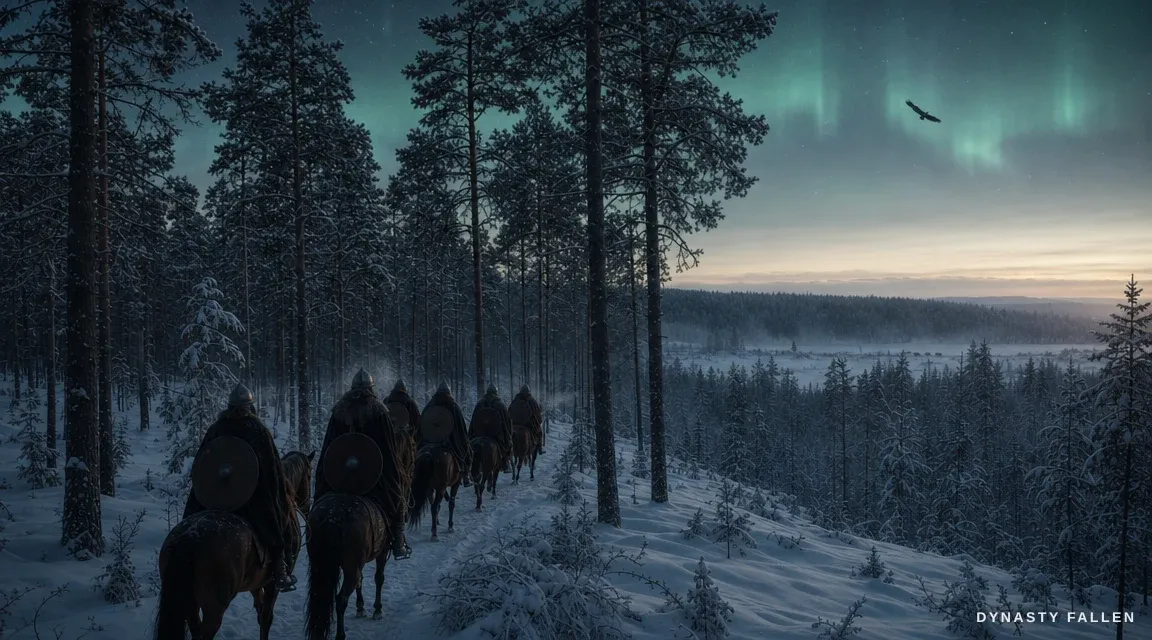
Six horsemen with the snow on their cloaks,
I gave them the wizards' names,
The wizards did not see the dawn.

Pre-Chorus 2
Thickening — jaw harp louder, tagelharpa escalating, frame drum galloping.

The smoke at the door, the breath of the cold,
The wolf-pelt closed at the throat for the ride,

Chorus 2
Stomping full band, women's chorus locked underneath, tagelharpa counter, lurr Norse horn restrained.

I named the wizards, I named the bed,
I named the night that I let them in,
Born of the bargain and the broken bone,
Mother of Kings, I rode the road.

Bridge
Drums drop to half-tempo stomp — pounding with weight, not dropping out. Bone flute solo above the jaw harp drone. Mezzo low chest.

The horse beneath, the hearth behind,
The wizards down, the wind ahead,
I did not turn to see the door,
I did not name what was already named,
The hut stood empty in the snow,
And the hut would burn by no one's hand.

Final Chorus
Biggest stomp — full band, lurr war horn hits on chorus downbeats, women's chorus locked, lead guitar holding through the second half. The closing couplet plants the album thesis.

I named the wizards, I named the road,
I named the men I would call my own,
Born of the wolf-pelt and the years to come,
Mother of Kings, I rode the years,
Six sons not yet born,
And the throne not yet named.

Outro
Drums hold one beat, jaw harp fading, hard cut on the final line. The witch's first withheld-magic line — the hut burns by no one's hand.

And the hut burned behind them, by no one's hand.
And the snow forgot the men.

The history

Mid-tenth century · Finnmark / Sámi frontier of Norway · a young Gunnhild alone in a turf-roofed hut with two seiðr-practitioners

Source: Heimskringla, Haralds saga hárfagra, ch. 32 (Snorri Sturluson, c. 1230)

Named figures

  • Gunnhildr konungamóðir (as a young woman, c. age 16) The pre-queen Gunnhild — in Snorri’s telling, alone in a hut on the Finnmark frontier learning seiðr from two Sámi wizards who keep her as their lover in exchange for the craft; the witch-queen origin in its most-dramatic form
  • The two Sámi wizards Snorri calls them simply Finnar — the Old Norse term for the Sámi peoples north of the Norse settlement zone. Killed by Erik’s men at Gunnhild’s request
  • Erik Bloodaxe (off-frame) Norwegian king on a sea-raid to Bjarmaland and the northern coast; sends his men inland, where they find the hut. Gunnhild rides south with them and becomes his queen

What this song renders

Snorri Sturluson’s Heimskringla, written c. 1230 from older saga tradition, places the episode on the Finnmark / Sámi frontier — the inland zone north of the Norse settlement belt where, in the medieval Norse imagination, seiðr-craft survived in its most archaic form. The narrative: Erik’s men ride inland, find a young woman alone in a turf-roofed hut with two Sámi wizards, learn she has been kept there to learn the craft — she has been the wizards’ lover so they would teach her. She asks Erik’s men to kill the wizards in their sleep. They do. She rides south with them and becomes Erik’s queen. The album takes this version because it is the version in which Gunnhild *chose*.

The historical record contradicts itself sharply on this point. Historia Norwegiae (Latin, c. 1170–1220) and Ágrip (Old Norse, c. 1190) record a different origin: Gunnhild as the daughter of Gorm the Old of Denmark and sister of Harald Bluetooth — a political marriage, no Sámi-frontier hut, no seiðr-bargain, no wizards. Both medieval traditions are older than Heimskringla. Modern scholarship has not resolved which to take seriously. The album takes Snorri (see the Truth, Saga & Legend page for the contrasting tradition). The opening track lands the saga origin within the first ninety seconds and lets it sit.

What’s documented is narrower than the saga: a queen named Gunnhild was the wife of Erik Bloodaxe, was the mother of the Eríkssynir, and ruled Norway in fact through her son Harald Greycloak for nearly a decade. The seiðr-frontier-hut origin is Snorri’s. The album commits to it, and the Sámi peoples are rendered as a coherent people on their own land — not as the saga’s exoticised ‘sorcerer’ trope.

Verdict

Saga-only. The Sámi-hut origin appears in Heimskringla and nowhere else; the continental tradition contradicts it. The album commits to the Heimskringla witch-queen frame and the Truth & Legend page documents the contradiction openly.

See the full Truth, Saga & Legend entry