Two lines spoken low-chest with a Norse breath, quoting the chronicler with contempt, over frame-drum gallop, war drums, palm-muted galloping electric guitar from the first beat. Then the band warms and the verse lands sung — mezzo gritty in mid-chest, bowed-lyre cold counter-line, bouzouki under. The passive constructions carry the trade narrative without claiming-which-people.
They wrote: a few wretched arrows, They wrote: the natives were frightened, They forgot the trade that came first, Furs were brought, and red cloth crossed, Milk was poured, and a feast was held, Peace was bartered, and peace was felt,
Three suns of trade, three suns of peace, On the fourth sun, the bull broke its lease,
Chorus
Full band, double-kick locked from this chorus onward, twin-guitar harmonies, women's chorus carrying the destiny voice, war horn on downbeats.
Iron and trade, the camp my pride, Three suns of peace and then it died, Salt and steel, the wave is mine, Erik's daughter, and the heir is mine.
Verse 2
Sung full band, palm-muted galloping guitars, bouzouki under, bowed lyre under. The three weeks of silence between the bull and the arrows.
Four suns of peace, then the bull broke free, It charged the brake, the Skrælingar fled, Three weeks of silence, the camp held breath, On the third week's night, they came armed for death,
Pre-Chorus 2
Thickening — double-kick under, war drums double, twin guitars rise.
Three weeks of silence, three weeks of dread, On the third week's night, the arrows fled,
Chorus 2
Full band louder, lead guitar harmony, women's chorus louder, war horn.
Iron and arrow, the camp my fight, Three weeks of silence, then the night, Salt and steel, the wave is mine, Erik's daughter, and the camp is mine.
Bridge
Drums half-time. A single low native flute leads — long sustained notes against a Norse bowed-lyre counter-melody, the album's gesture of musical respect to the Skrælingar as a people with their own music. Soprano lift on ‘flare’ carries the mode-change from peace to attack. Women's chorus underneath.
They came in trade, hands open and bare, They came in dark, eyes lit with flare, The first arrow rose past the watch-fire's glow, The third arrow struck a man they'd known.
Instrumental
Eight bars — soaring lead guitar with native flute counter-line. Roughly thirteen seconds.
Final Chorus
Full band biggest, double-kick locked, twin-guitar harmonies, women's chorus locked, war horn on every hit. The album-thesis seed plants on the closing line.
Iron and arrow, the camp aflame, Three weeks of silence, and then they came, Salt and storm, the wave is mine, Erik's daughter, and the saga is mine.
Outro
Drums fade to a single beat, bowed-lyre final phrase, hard cut. The Hóp transition seed — Track 05 is the bareblade.
First arrows fell, and the next will too, The dawn at Hóp — and the saga knew.
From the music video
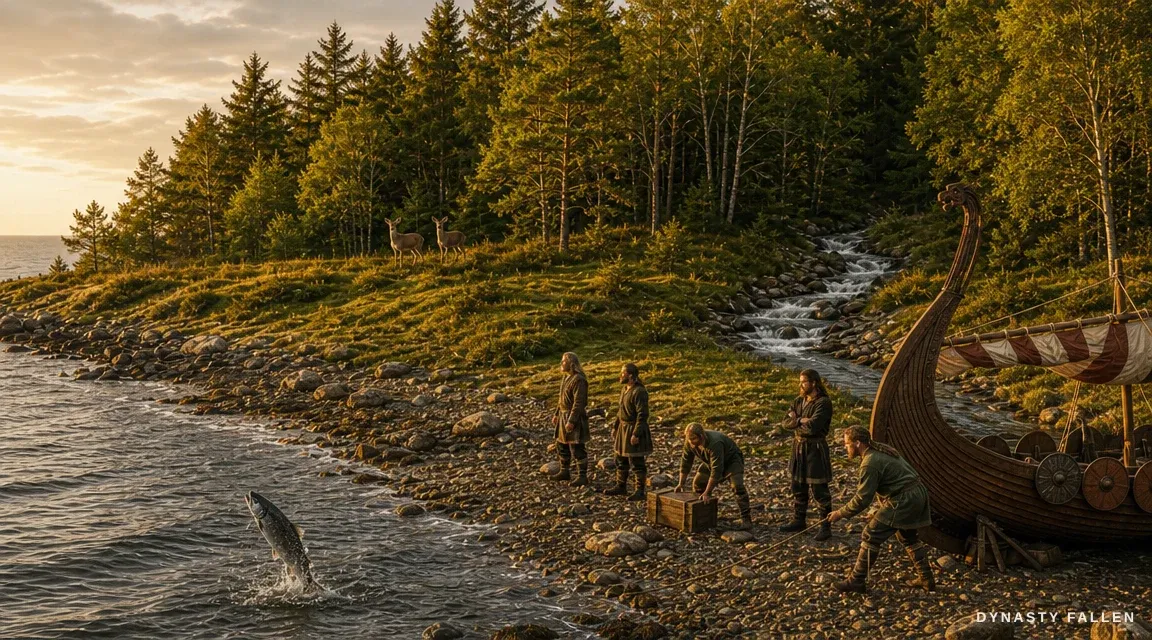
Vinland Camp Threshold — establishing shotVinland Trade Clearing — establishing shotVinland Trade Clearing — wide shotVinland Camp Night Under Arrows — establishing shotVinland Camp Night Under Arrows — establishing shot
The history
Early eleventh century · the Vinland camp on the L’Anse aux Meadows / Hóp coast · first contact, the trade, the bull, and the night arrows
Source: Eiríks saga rauða (Hauksbók, Skálholtsbók); Grœnlendinga saga (Flateyjarbók); modern scholarship on the L’Anse aux Meadows excavations and Norse–Indigenous Maritime first contact (Wallace, Ingstad, Sutherland)
Named figures
Þorfinnr KarlsefniIcelandic-Norse expedition leader; the saga records his fleet trading with the Skrælingar — furs and red cloth and a feast — before the bull broke free and the violence began
Thorbrandr SnorrasonNorse crewman on the Karlsefni expedition; killed in the violence the next track records. Appears in this track silent at the camp, setup for the fallen sword Freydís will pick up at Hóp
Freydís EiríksdóttirVisibly pregnant at the camp threshold; the iron sword is not yet in her hand. Track 04 is the song before the bareblade
The SkrælingarThe Norse name for the Indigenous peoples encountered in Vinland — almost certainly the ancestors of the Beothuk and/or the Mi’kmaq of Newfoundland and the Maritimes. Rendered in the track as a coherent people, not a threat-construct: trading partners, then fleeing the bull, then arriving in the dark
What this song renders
Both sagas record the trade that came first. Eiríks saga rauða describes the Skrælingar arriving at the Karlsefni camp with furs and grey skins to barter, Karlsefni’s men offering red cloth and dairy in exchange — a documented exchange of goods preserved on both sides of the saga record. The trade lasted some days. Then the bull, a single Norse-imported bovine the expedition had brought to Vinland, broke free of its tether and charged through the trade clearing; the Skrælingar fled into the forest. Three weeks later, the saga records, they returned in greater numbers and the violence began.
The track corrects the chronicle’s framing without softening the violence. The Skrælingar “wretched arrows” line is the chronicler’s phrase — quoted with contempt in the cold-open spoken anaphora. The song’s sung answer is that the trade came first, that both peoples acted under pressure, and that the kill in the bridge — “the third arrow struck a man they’d known” — is the dramatic-irony cost of a contact moment that was, briefly, a meeting. The single low native flute on the bridge is the album’s gesture of musical respect to the Skrælingar as a people with their own music.
The visual rendering follows the album’s cultural-respect protocol: the Skrælingar appear in period-accurate sealskin and caribou-hide garments with red ochre, birchbark canoes at the forest-edge, longhouse-style winter shelters visible at distance — the Maritime Indigenous reality, not the Plains-warrior trope the AI training-set defaults to. No feathered headdresses; no horses (no horses in pre-contact Eastern Maritime). The track holds blood-restraint: arrows fall on the camp timber, not on shown bodies; blood is reserved for the next track at Hóp.
Verdict
The Karlsefni trade with the Skrælingar, the bull breaking free, the three weeks of silence, and the night arrow attack are documented in both sagas — this is one of the album’s most archaeologically and textually anchored episodes. The cultural-respect framing of the Skrælingar as trading partners and a coherent people with their own valid claim is the album’s reading, not the chronicler’s — but the trade and the food shared and the “man they’d known” ambiguity are all in the saga record.