ii.

Iron and Ice

Act I — Daughter of Erik Released Approx. 3:29
Verse 1
Two lines spoken low-chest with a Norse breath over Hardanger fiddle in cold register and a frame-drum heartbeat, then the rest of the verse lands sparse and sung — palm-muted clean guitar, the mezzo finding the cold register.

Before the bareblade, before the sword,
Before any saga of mine was scored,
There was a child on the Greenland ice,
Born to the cold, learning the price,
Erik my father, outlawed away,
Three ships rose, no land to stay,

Pre-Chorus
Tightening — frame-drum slow gallop, Hardanger fiddle melancholy.

Three winters dark, three summers thin,
A daughter learns the cold within,

Chorus
Full band entering, tribal war drums, women's chorus locked under the lead, Norse lurr horn on the downbeats, minor key.

Iron and ice, the long dark years,
Greenland made me, Greenland hears,
Frost and salt, the keel my home,
I am Erik's daughter, ice-grown.

Verse 2
Sung full band, palm-muted galloping guitars, Hardanger doubling the vocal melody.

We learned the seal-hunt at the ice,
We learned the long dark, paid its price,
My brothers swung axe and learned the shield,
I swung beside them — same hard field,

Pre-Chorus 2
Thickening — frame drum doubling, Hardanger fiddle rising.

Three winters past, three more arrived,
A daughter learns how she survived,

Chorus 2
Full band louder, lead guitar harmony layered with the rhythm, women's chorus louder, minor key.

Iron and ice, the long dark years,
Greenland made me, Greenland hears,
Frost and salt, the blade my home,
I am Erik's daughter, axe-grown.

Bridge
Drums half-time, Hardanger fiddle solo entering, soprano lift arriving on lines one and four — the survival reframing, women's chorus underneath.

The ice did not break me, the ice was kin,
The dark did not break me, the dark ran thin,
What men called soft, what men called slight,
The Greenland answered: she will fight.

Instrumental
Eight bars — lead guitar over Hardanger fiddle counterpoint. Roughly seventeen seconds.
Final Chorus
Full band biggest, lead guitar over the second half, women's chorus locked, war horn on every hit.

Iron and ice, the long dark years,
Greenland made me, Greenland hears,
Frost and salt, the world my home,
I am Erik's daughter — ice-and-storm.

Outro
Drums fade to a single beat, Hardanger fiddle alone, hard cut on the last line.

Daughter of Greenland, daughter of cold,
The ice was mine before the gold.

The history

Late tenth century · the Eastern Settlement at Brattahlíð · Freydís as a child learning the Greenland cold years

Source: Eiríks saga rauða; Grœnlendinga saga; Landnámabók; modern scholarship on Norse-Greenland subsistence and the Eastern Settlement archaeology (Jesch, Magnusson, Arneborg)

Named figures

  • Erik the Red Freydís’s father; outlawed twice from Iceland (c. 982); founded the Greenland colony c. 985 and headed the Eastern Settlement at Brattahlíð (modern Qassiarsuk)
  • Freydís Eiríksdóttir (as a child, c. age 10–12) Third generation, first daughter; raised on the Eastern Settlement through the Greenland cold years — the environment the album argues as the forge for the woman she becomes
  • Thjodhild Erik the Red’s wife and Freydís’s stepmother; built the first small church at Brattahlíð after her conversion. Freydís’s birth-mother is unnamed in the documentary record

What this song renders

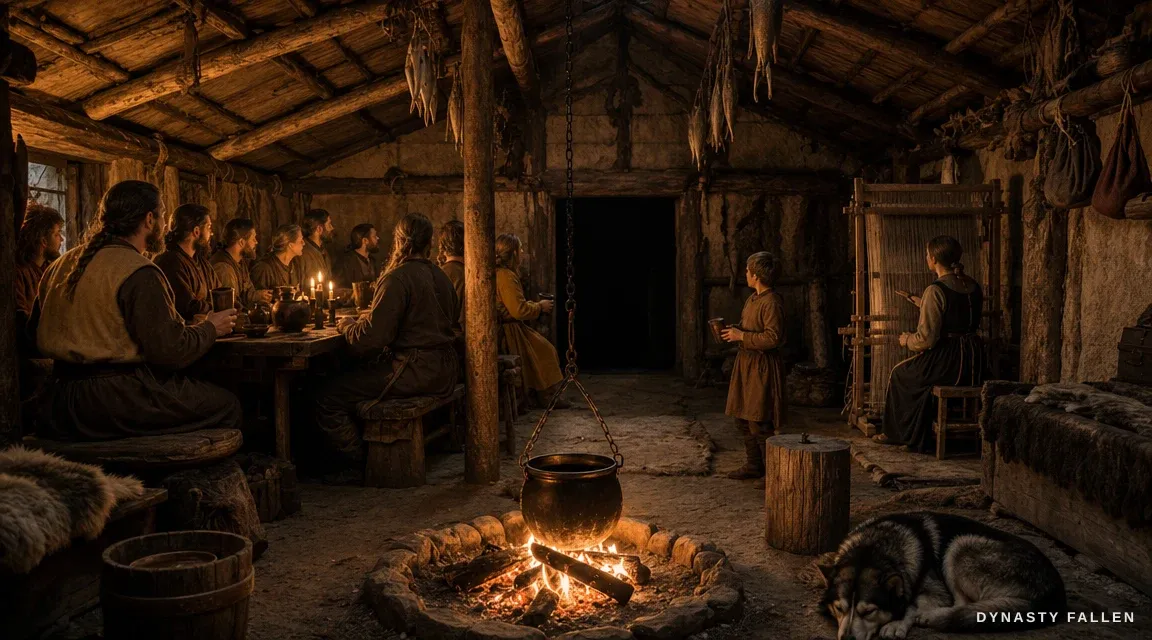
The Greenland Eastern Settlement was founded c. 985 by Erik the Red after his second Iceland outlawry, and survives in the archaeological record at Brattahlíð (modern Qassiarsuk) — turf-roofed longhouses, the small church Thjodhild built after her conversion, evidence of seal-hunt, sheep-pasture, and subsistence farming on the southern Greenland coast. The settlement endured into the fifteenth century. Erik’s children — Leif, Thorvald, Thorstein, and Freydís — grew up in this landscape.

Freydís’s specific childhood is not documented. The two sagas pick her story up when she is an adult, in Vinland. But the Norse-Greenland subsistence cycle of the late tenth century is well-recovered: the seal-hunt at the ice edge in autumn and winter, the long-dark months of cold-storage and fire-tending, the warrior-training that Norse children of both sexes received in axe and shield work. The track lays the cold years onto the documentary frame and lets the chorus argue what the saga record leaves silent — that the woman who picks up the bareblade at Hóp was forged here, in the Greenland years, before the saga starts.

The musical spine — Hardanger fiddle, frame-drum heartbeat, female mezzo with soprano lift — is the album’s identity instrument. Track 02 introduces it in survival register: slower than Track 01, minor key throughout, the soprano lift reserved for the bridge moment where external judgement gets inverted.

Verdict

The Eastern Settlement, Erik’s outlawry chain, and the Greenland founding c. 985 are documented. Freydís’s childhood there is a reasonable inference from the family’s confirmed presence at Brattahlíð — not a saga episode. The track invents no dramatic events; it argues a thematic claim about what the cold years made possible, and lets the documentary record carry the setting.

Read the full Truth, Saga & Legend page