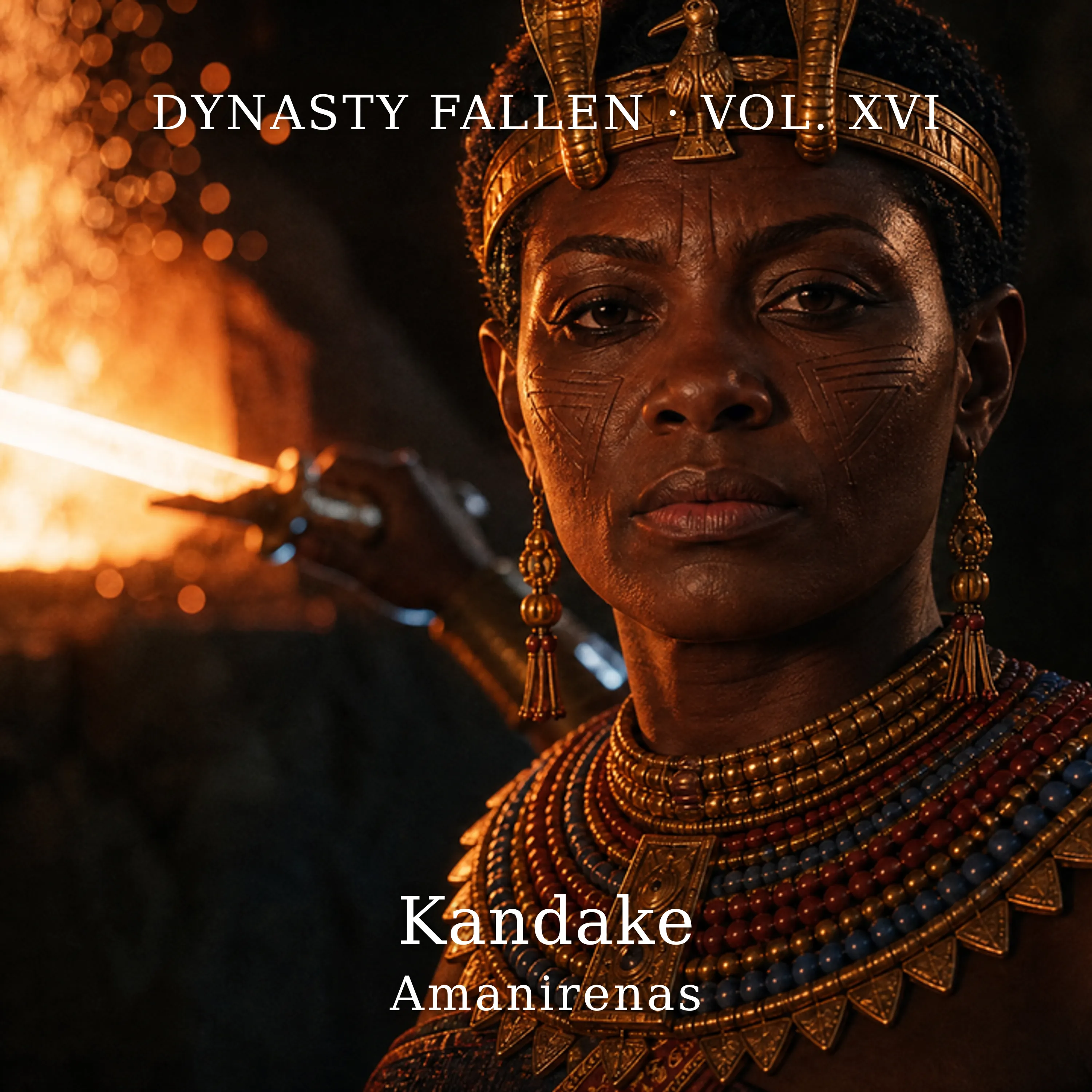
Dynasty Fallen · Vol. XVI

Amanirenas
the One-Eyed Kandake

The One-Eyed Kandake. Iron queen of Kush. The woman who made Rome sit down.
Send your face south to rule us — we'll wipe our feet on it.

The story

First century BC
Meroë, the Nile, and the Roman frontier
The iron kingdom against Augustus's Rome

Amanirenas was the Kandake of Kush — the ruling warrior-queen of a Nubian iron empire on the upper Nile, governing from Meroë in the years after Rome swallowed Egypt. When Augustus’s new province reached the first cataract and began taxing toward the south, she did not wait to be annexed. Kushite forces came down on Syene, Elephantine and Philae, threw down the imperial statues, and carried an over-life-size bronze head of Augustus home as loot. Rome sent Gaius Petronius after her. He won his battles, marched to Napata and burned it — and still could not keep the desert. In 21/20 BC her envoys reached Augustus on Samos and came home with the frontier pulled back and, the part that matters, no tribute.

The record splits on who won, and Vol. XVI does not close the split — it makes the split the closing argument. Strabo gives us the Roman version: a queen defeated, a clemency granted. The Kushite monuments give us the other, in a language nobody can read. What survives whole and unambiguous is an object: the bronze emperor’s head, buried face-up in clean sand beneath a temple stairway at Meroë, so that every worshipper climbing to the altar put a foot on Caesar. It was still there in December 1910. Rome wrote it “peace.” Kush kept the head.

The album’s engine is different from the rest of the catalogue. Boudicca loses. Zenobia loses. Cleopatra loses. Amanirenas wins — and the discipline is to keep the win cold, because it was paid for. She gives an eye to it. She gives a son to it. The Roman brass-march that arrives in Act I is never answered by a triumphal fanfare of Kush’s own; it is simply overpowered by war-drums, and never gets the frame back.

“Blind in one eye — and I still watched Rome leave.”

Eight tracks in three acts: The Cataract, the iron kingdom and the god Rome sends south to stand on its border; The March North, the assault, the wound, and the river that takes Akinidad; and The Head, where the bronze goes under the threshold and the peace comes back owing nothing. The cautious history and the album’s first-person version stand side by side — this page and the one beside it are so you can hold both at once.

Album in active production. 1 of 1 tracks released.

Music videos

Out now.

The album opens on the iron kingdom before Rome arrives — Meroë's furnaces, its steep dark pyramids, and a queen whose title Rome could only mispronounce. The thesis lands in the centrepiece: the bronze head of Augustus goes into a pit beneath a temple threshold, face up, so that everyone who crosses it steps on the emperor.

Track list

One tracks. Three acts.

Three acts: the cataract, where Rome sends a god south to stand on the border; the march north, the wound, and the son the river takes; and the head — the buried bronze, and a peace that cost Kush no tribute at all.

Act I — The Cataract
01 Kandake Lyrics →

Questions

About Amanirenas.

The short answers — with links into the lyrics and the annotated history where the record gets interesting.

Who was Amanirenas?
Amanirenas was the Kandake — the ruling warrior-queen — of the Kingdom of Kush, in what is now Sudan, reigning from the city of Meroë in the late first century BC. She carried the titles qore and kandake together, which marks her as a queen ruling in her own right rather than a king's consort. She is remembered for the war she fought against Augustus's Rome between roughly 25 and 21 BC, for the eye she lost in it, and for the peace she forced that laid no tribute on her kingdom. Dynasty Fallen Vol. XVI tells that war from Kush's side across eight tracks.
Did Amanirenas really defeat the Roman Empire?
The record is genuinely split, and the album is built on the split. Kush struck first, taking Syene, Elephantine and Philae while the Roman prefect was away campaigning in Arabia, and throwing down the imperial statues. Gaius Petronius counter-marched, beat the Kushite army in the field, and pushed as far as Napata, which he razed. But Rome could not hold the deep desert, and the settlement negotiated with Augustus at Samos in 21/20 BC pulled the frontier back and — the part that matters — imposed no tribute on Kush. Roman sources frame that as the emperor's clemency. Kushite monuments frame the whole war as a victory. Neither side is lying; they are counting different things.
How did Amanirenas lose her eye?
Strabo, writing within living memory of the war, describes the Kushite queen as blind in one eye. He does not say how it happened, and no other source does either. The tradition that she lost it in the fighting is an inference — a reasonable one, given where and when the description appears, but an inference. Some modern writers read the blindness as congenital or the result of illness. The album takes the war-wound reading and is open about it being a reading.
What is the Meroë Head?
An over-life-size bronze portrait head of the emperor Augustus, with inset glass pupils and calcite irises that still stare. It was cut from a full statue looted from Roman Egypt during the war and carried south to Meroë, where it was buried in clean sand beneath the steps of a temple — almost certainly so that everyone climbing to the altar would put a foot on the emperor's face. It lay there for nearly two thousand years until the British archaeologist John Garstang excavated it in December 1910. It is now in the British Museum.
Where was the Kingdom of Kush, and where is Meroë?
Kush was a Nubian kingdom on the Nile upstream of Egypt, in what is today northern Sudan. Meroë — its capital in this period — stands on the east bank of the Nile between the fifth and sixth cataracts, north of Khartoum. Its royal necropolis holds more pyramids than all of Egypt, but they are Meroitic: steeper, smaller and far more numerous than the Giza silhouette most people picture. Meroë was also a major iron-producing city, which is why this album's sound is built on forge and war-drum rather than court and harp.
Who was Akinidad?
A Meroitic prince who appears alongside Amanirenas on the Hamadab stela and other monuments, generally taken by scholars to be her son and co-commander during the Roman war. The precise family relationships between the Kushite royals of this generation are not securely established, because Meroitic can be read aloud but barely understood — the script was cracked in 1909, yet only a few dozen words of the language are securely known. We can see the names side by side; we cannot read the sentence that would tell us how they were related. He appears to have died during the war years; the album gives him a river-funeral it does not claim to document.
What is the Hamadab stela?
A first-century-BC sandstone victory stela found at Hamadab near Meroë, carrying some forty-five rows of Meroitic text and showing Amanirenas and Akinidad before the gods with bound prisoners beneath them. It is widely read as commemorating the Roman war — but that reading rests on the imagery and the context rather than the words, because the Meroitic language behind the readable script is still barely understood. It is the closest thing we have to Kush's own account of the war, and we can pronounce it without knowing what it says.
What did Rome call her — was she 'Candace'?
Kandake was a Kushite title for the ruling or royal woman, not a personal name. Greek and Roman writers heard it as a name and rendered it Candace, which is how it entered European languages — and how it reached the New Testament's "Candace, queen of the Ethiopians." So Rome spent a three-year war addressing her office and believing it was addressing her. The album's opening track is built on exactly that.

Where to listen

New tracks drop through the cycle.

Stream the album on your service of choice. Music videos go up on YouTube.